
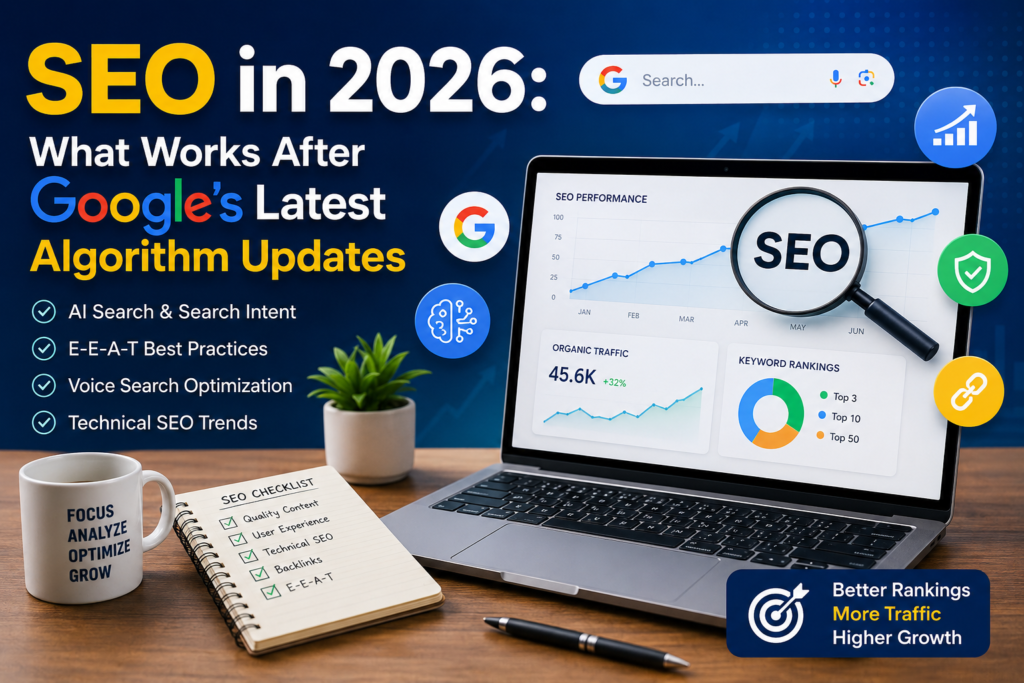
Search Engine Optimization (SEO) is evolving faster than ever. If you’ve noticed changes in your website rankings, traffic fluctuations, or shifts in how Google displays search results, you’re not alone. Google’s latest algorithm updates have transformed the SEO landscape, making it essential for businesses and marketers to adapt their strategies.
The good news? SEO is far from dead. In fact, it’s more important than ever. The key is understanding what works in 2026 and aligning your content with Google’s focus on quality, user experience, and expertise.
In this guide, we’ll explore the latest SEO trends, algorithm changes, and actionable strategies that can help your website rank higher and attract more organic traffic.
Why SEO Matters More Than Ever in 2026
With millions of websites competing for attention, SEO remains one of the most cost-effective ways to generate long-term traffic and leads. Unlike paid advertising, organic search continues to deliver results long after content is published.
Google’s mission has always been to provide users with the most relevant and helpful information. Recent updates have reinforced this mission by rewarding websites that offer genuine value while penalizing low-quality, AI-generated spam, and keyword-stuffed content.
If your goal is to increase visibility, build authority, and grow your business online, SEO should remain a core part of your digital marketing strategy.
Google’s Latest Algorithm Updates: What’s Changed?
Over the past few years, Google has introduced several updates designed to improve search quality. These updates focus heavily on:
1. Helpful, People-First Content
Google now prioritizes content written for users rather than search engines. Articles created solely to rank for keywords without providing meaningful information are losing visibility.
To succeed, focus on:
- Solving real user problems
- Providing actionable insights
- Sharing original experiences and expertise
- Creating comprehensive content
The question to ask yourself is simple: “Would someone find this content useful even if they didn’t arrive from Google?”
If the answer is yes, you’re moving in the right direction.
2. E-E-A-T Is More Important Than Ever
Google evaluates content using the E-E-A-T framework:
- Experience
- Expertise
- Authoritativeness
- Trustworthiness
Websites that demonstrate real-world experience and industry knowledge are more likely to rank well.
For example, if you’re writing about digital marketing, include practical examples, case studies, campaign results, and personal insights. This helps establish credibility and trust with both users and search engines.
SEO Strategies That Work in 2026
Let’s look at the most effective SEO techniques businesses should implement today.
Focus on Search Intent
Search intent refers to the reason behind a user’s search query.
For example:
- “What is SEO?” = informational intent
- “Best SEO tools” = commercial intent
- “Buy SEO software” = transactional intent
Google has become exceptionally good at understanding intent. That’s why simply targeting keywords is no longer enough.
Before creating content, determine:
- What information users want
- What type of content ranks currently
- What questions users are asking
When your content matches user intent, rankings improve naturally.
Optimize for AI-Powered Search
AI is changing how people search online. Search engines now generate summaries, answer questions directly, and provide conversational responses.
To improve visibility:
- Use clear headings and subheadings
- Answer common questions directly
- Structure content logically
- Include concise definitions and explanations
- Create FAQ sections
Well-structured content has a better chance of being featured in AI-generated search results.
Create Topic Clusters Instead of Single Articles
Rather than publishing random blog posts, successful websites are building content ecosystems.
For example:
Main Topic:
- SEO Guide
Supporting Articles:
- Keyword Research Tips
- On-Page SEO Checklist
- Technical SEO Guide
- Link Building Strategies
- Local SEO Best Practices
This approach helps Google understand your expertise and authority on a subject.
Technical SEO Still Matters
While content is critical, technical SEO remains the foundation of strong rankings.
Improve Website Speed
Users expect websites to load instantly. A slow website leads to:
- Higher bounce rates
- Poor user experience
- Lower rankings
Optimize:
- Images
- Code
- Hosting performance
- Mobile responsiveness
Fast websites consistently perform better in search results.
Mobile-First Optimization
Most searches now happen on mobile devices.
Make sure your website:
- Loads quickly on smartphones
- Has responsive design
- Uses readable fonts
- Provides easy navigation
A poor mobile experience can significantly impact rankings and conversions.
Secure Your Website
Security continues to be a ranking factor.
Always use:
- HTTPS encryption
- Secure hosting
- Updated plugins and software
A secure website builds trust with both users and search engines.
The Growing Importance of User Experience
Google increasingly measures how users interact with your website.
Positive signals include:
- Longer time on page
- Low bounce rates
- High engagement
- Easy navigation
To improve user experience:
- Use short paragraphs
- Add visuals and graphics
- Break up content with headings
- Include internal links
- Make information easy to find
Remember, SEO is no longer just about rankings. It’s about creating a better experience for your audience.
Link Building in 2026
Backlinks remain a strong ranking factor, but quality matters more than quantity.
Effective link-building methods include:
Publish Original Research
Unique data naturally attracts links from other websites.
Guest Posting
Contribute valuable content to reputable industry blogs.
Create Shareable Resources
Examples include:
- Templates
- Checklists
- Industry reports
- Free tools
The more useful your content is, the more likely people are to link to it.
Common SEO Mistakes to Avoid
Many websites still struggle because they continue using outdated tactics.
Avoid:
- Keyword stuffing
- Buying backlinks
- Publishing thin content
- Ignoring mobile optimization
- Creating content solely for search engines
- Neglecting technical SEO
Modern SEO rewards quality, relevance, and user satisfaction.
The Future of SEO
SEO will continue evolving as AI becomes more integrated into search.
However, one thing remains constant: Google wants to deliver the best possible experience to users.
Businesses that focus on helping their audience, demonstrating expertise, and creating high-quality content will continue to succeed regardless of algorithm updates.
Instead of chasing every ranking trick, invest in building authority, trust, and valuable content. These fundamentals will always remain at the heart of successful SEO.
Final Thoughts
SEO in 2026 is no longer about finding shortcuts to rank higher. It’s about understanding your audience, creating genuinely helpful content, and delivering an outstanding user experience.
By focusing on search intent, E-E-A-T, technical optimization, and content quality, you can stay ahead of Google’s algorithm updates and achieve sustainable organic growth.
Whether you’re a business owner, marketer, freelancer, or aspiring digital marketing professional, mastering modern SEO can open up tremendous opportunities for growth.
Ready to Master SEO and Digital Marketing?
Want to learn the latest SEO strategies, Google Ads, social media marketing, content marketing, and AI-powered digital marketing techniques from industry experts?
Enroll in our Digital Marketing Training Program today and gain practical, hands-on skills that help you grow your business, advance your career, or start your own digital marketing agency.
Contact us now to reserve your seat and take the first step toward becoming a successful digital marketer!
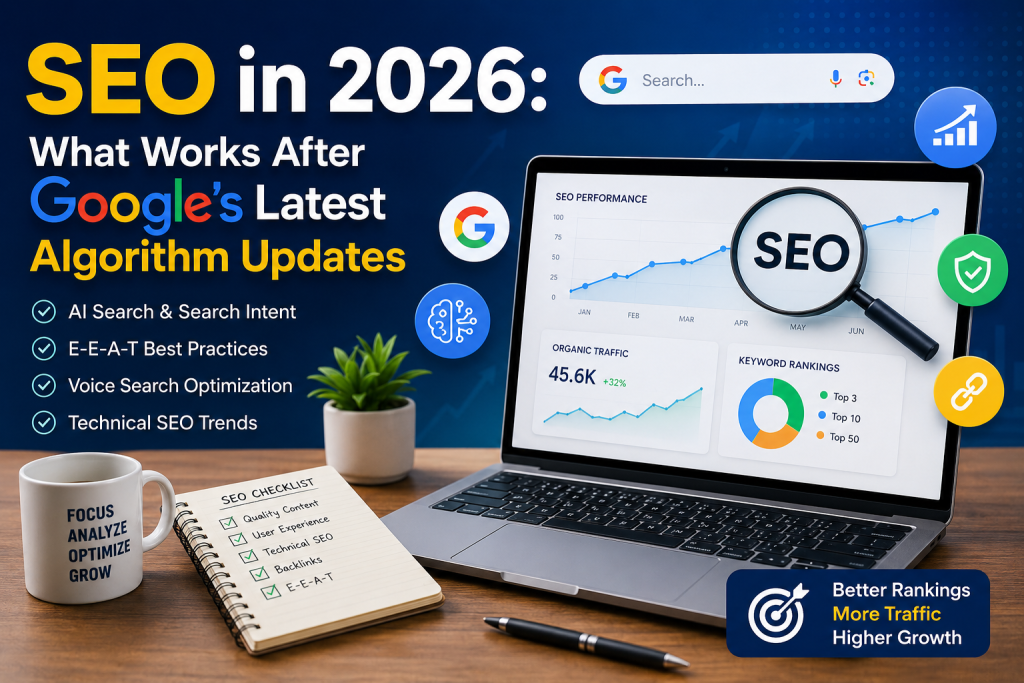
Search Engine Optimization (SEO) is evolving faster than ever. If you’ve noticed changes in your website rankings, traffic fluctuations, or shifts in how Google displays search results, you’re not alone. Google’s latest algorithm updates have transformed the SEO landscape, making it essential for businesses and marketers to adapt their strategies.
The good news? SEO is far from dead. In fact, it’s more important than ever. The key is understanding what works in 2026 and aligning your content with Google’s focus on quality, user experience, and expertise.
In this guide, we’ll explore the latest SEO trends, algorithm changes, and actionable strategies that can help your website rank higher and attract more organic traffic.
Why SEO Matters More Than Ever in 2026
With millions of websites competing for attention, SEO remains one of the most cost-effective ways to generate long-term traffic and leads. Unlike paid advertising, organic search continues to deliver results long after content is published.
Google’s mission has always been to provide users with the most relevant and helpful information. Recent updates have reinforced this mission by rewarding websites that offer genuine value while penalizing low-quality, AI-generated spam, and keyword-stuffed content.
If your goal is to increase visibility, build authority, and grow your business online, SEO should remain a core part of your digital marketing strategy.
Google’s Latest Algorithm Updates: What’s Changed?
Over the past few years, Google has introduced several updates designed to improve search quality. These updates focus heavily on:
1. Helpful, People-First Content
Google now prioritizes content written for users rather than search engines. Articles created solely to rank for keywords without providing meaningful information are losing visibility.
To succeed, focus on:
- Solving real user problems
- Providing actionable insights
- Sharing original experiences and expertise
- Creating comprehensive content
The question to ask yourself is simple: “Would someone find this content useful even if they didn’t arrive from Google?”
If the answer is yes, you’re moving in the right direction.
2. E-E-A-T Is More Important Than Ever
Google evaluates content using the E-E-A-T framework:
- Experience
- Expertise
- Authoritativeness
- Trustworthiness
Websites that demonstrate real-world experience and industry knowledge are more likely to rank well.
For example, if you’re writing about digital marketing, include practical examples, case studies, campaign results, and personal insights. This helps establish credibility and trust with both users and search engines.
SEO Strategies That Work in 2026
Let’s look at the most effective SEO techniques businesses should implement today.
Focus on Search Intent
Search intent refers to the reason behind a user’s search query.
For example:
- “What is SEO?” = informational intent
- “Best SEO tools” = commercial intent
- “Buy SEO software” = transactional intent
Google has become exceptionally good at understanding intent. That’s why simply targeting keywords is no longer enough.
Before creating content, determine:
- What information users want
- What type of content ranks currently
- What questions users are asking
When your content matches user intent, rankings improve naturally.
Optimize for AI-Powered Search
AI is changing how people search online. Search engines now generate summaries, answer questions directly, and provide conversational responses.
To improve visibility:
- Use clear headings and subheadings
- Answer common questions directly
- Structure content logically
- Include concise definitions and explanations
- Create FAQ sections
Well-structured content has a better chance of being featured in AI-generated search results.
Create Topic Clusters Instead of Single Articles
Rather than publishing random blog posts, successful websites are building content ecosystems.
For example:
Main Topic:
- SEO Guide
Supporting Articles:
- Keyword Research Tips
- On-Page SEO Checklist
- Technical SEO Guide
- Link Building Strategies
- Local SEO Best Practices
This approach helps Google understand your expertise and authority on a subject.
Technical SEO Still Matters
While content is critical, technical SEO remains the foundation of strong rankings.
Improve Website Speed
Users expect websites to load instantly. A slow website leads to:
- Higher bounce rates
- Poor user experience
- Lower rankings
Optimize:
- Images
- Code
- Hosting performance
- Mobile responsiveness
Fast websites consistently perform better in search results.
Mobile-First Optimization
Most searches now happen on mobile devices.
Make sure your website:
- Loads quickly on smartphones
- Has responsive design
- Uses readable fonts
- Provides easy navigation
A poor mobile experience can significantly impact rankings and conversions.
Secure Your Website
Security continues to be a ranking factor.
Always use:
- HTTPS encryption
- Secure hosting
- Updated plugins and software
A secure website builds trust with both users and search engines.
The Growing Importance of User Experience
Google increasingly measures how users interact with your website.
Positive signals include:
- Longer time on page
- Low bounce rates
- High engagement
- Easy navigation
To improve user experience:
- Use short paragraphs
- Add visuals and graphics
- Break up content with headings
- Include internal links
- Make information easy to find
Remember, SEO is no longer just about rankings. It’s about creating a better experience for your audience.
Link Building in 2026
Backlinks remain a strong ranking factor, but quality matters more than quantity.
Effective link-building methods include:
Publish Original Research
Unique data naturally attracts links from other websites.
Guest Posting
Contribute valuable content to reputable industry blogs.
Create Shareable Resources
Examples include:
- Templates
- Checklists
- Industry reports
- Free tools
The more useful your content is, the more likely people are to link to it.
Common SEO Mistakes to Avoid
Many websites still struggle because they continue using outdated tactics.
Avoid:
- Keyword stuffing
- Buying backlinks
- Publishing thin content
- Ignoring mobile optimization
- Creating content solely for search engines
- Neglecting technical SEO
Modern SEO rewards quality, relevance, and user satisfaction.
The Future of SEO
SEO will continue evolving as AI becomes more integrated into search.
However, one thing remains constant: Google wants to deliver the best possible experience to users.
Businesses that focus on helping their audience, demonstrating expertise, and creating high-quality content will continue to succeed regardless of algorithm updates.
Instead of chasing every ranking trick, invest in building authority, trust, and valuable content. These fundamentals will always remain at the heart of successful SEO.
Final Thoughts
SEO in 2026 is no longer about finding shortcuts to rank higher. It’s about understanding your audience, creating genuinely helpful content, and delivering an outstanding user experience.
By focusing on search intent, E-E-A-T, technical optimization, and content quality, you can stay ahead of Google’s algorithm updates and achieve sustainable organic growth.
Whether you’re a business owner, marketer, freelancer, or aspiring digital marketing professional, mastering modern SEO can open up tremendous opportunities for growth.
Ready to Master SEO and Digital Marketing?
Want to learn the latest SEO strategies, Google Ads, social media marketing, content marketing, and AI-powered digital marketing techniques from industry experts?
Enroll in our Digital Marketing Training Program today and gain practical, hands-on skills that help you grow your business, advance your career, or start your own digital marketing agency.
Contact us now to reserve your seat and take the first step toward becoming a successful digital marketer!